Showing posts with label Tub King. Show all posts

SOLID SURFACE BATHTUBS- THE CENTERPIECE OF YOUR MASTER BATH

By Alan Knight

In the past, the bathroom was mostly considered to be a utilitarian space where you take care of your daily ablutions and you’re done. But alas, these times are changing. Your home is your refuge and the trend is to upgrade your refuge to provide the epitome of comfort and luxury. 

Courtesy of flickr.com

Is there anything more luxurious and relaxing than a spa-like master bathroom? I don’t think so. There is nothing like ending a long, stressful day with a self-indulgent, healing soak in your bathtub to wash away your daily woes.

THE CENTERPIECE

The centerpiece of modern bathroom design has become the freestanding bathtub. These bathtubs have become works of art. The simple and elegant design dictates the mood of the room. It says, this room is my spa.
As a consumer, you know what you want and quality and endurance are essential. If you are going to upgrade your master bathroom and create a spa-like atmosphere, you want your bathtub centerpiece to be of the highest quality and most sleek design.

They are finally here.

SOLID SURFACE BATHTUBS AT TUB KING

After countless requests for newer, more contemporary bathtubs, we are proud to introduce our new line of Solid Surface Bathtubs. It is the essential element in the creation of a modern master bathroom.

These tubs are made of a material called solid surface, a man-made stone also known by its brand name, Corian. Once dubbed a “space age” material, it is a non-porous, low maintenance material and virtually scratch-resistant. It is mainly used for sinks and countertops.

 By using this solid surface material, shapes and designs can be achieved that are only possible by using acrylics and plastics. The inferior materials do not retain heat and tend to bow and flex and eventually crack over time. These solid surface tubs are easy to clean and will retain their new look for years to come. They can provide the same, warm bathing experience as their cast iron ancestors while giving your master bathroom the spa-like atmosphere you are seeking.

ONLY THE HIGHEST QUALITY AT TUB KING

We are proud of the work we do here at Tub King and only align ourselves with the best products and designers. We are happy to align ourselves with Clarke Architectural, an innovator in contemporary bathroom fixture design. Using advanced technologies, their products are not only timeless and elegant, but designed to last a lifetime. Whether it is a Tub King Solid Surface Tub or a Clark Architectural brand tub, you know you are purchasing the highest quality tub on the market today.

Clarke Architectural products are made exclusively of OMOXO™ solid surface compound. This proprietary formulation is comprised of a high concentration of Lucite® liquid acrylic resin as a bonding agent, plus polymerized granules to develop the beautiful color and distinctive finish utilized throughout our entire product line. Although more expensive to manufacture, we strongly believe in using only premium grade materials to achieve a natural beauty that can stand up to the rigors of daily use without compromise. Clarke Architectural solid surface products are manufactured exclusively in the United States. Each piece is hand detailed to a matte or satin finish. Go beyond simple expectations of traditional bath products, and choose to showcase a functional piece of art that is both timeless in design and built for life.”

THE CREATIONS

THE 70” ELSYIUM 
There are 18 stunning styles to choose from and all will deliver that warm and blissful bathing experience you desire.

Let’s take a look at some of the works of art that can be yours.

THE 70” ELSYIUM 


The Elsyium solid surface bathtub will transform your master bath into a modern day paradise. The solid surface construction allows you to take a lingering, soothing, warm bath that will bring you the relaxation and peace you desire.

THE 66” EDEN
THE 66” EDEN 


This stunner, with its sleek, oval silhouette will make you and your contemporary master bathroom the envy of the neighborhood. Though it can be positioned anywhere in the space, this work of art belongs where it will get the most attention- right in the middle of the room. To make more impact, this stylish tub also comes in black.
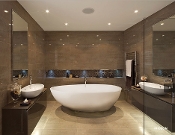
THE 71” IRIDEON
THE 71” IRIDEON


The striking structure of the Irideon offers a refreshing, modern look.  The well-designed silhouette and curvature of the Irideon form a unique shape that is stunning at any angle. The deep, freestanding tub allows for complete immersion, creating the perfect space for relaxation.


THE 72” LOTUS

THE 72” LOTUS
Sensual to the feel and striking in appearance, the Lotus reflects a sense of elegance designed to stand on its own as the main element of any bathroom. The velvety finish and sophisticated profile of the Lotus create a solid surface bath that is both practical and beautiful. The well-designed silhouette and curvature of the Lotus forms a unique shape that is stunning at any angle.


THE 70” LAVASCA

THE 70” LAVASCA


The sleek and stylish Lavasca bathtub is both functional and elegant. The freestanding soaker combines luxury with practicality enhancing the décor in any bathroom. Designed by Matteo Thun and Rapsel of Italy, the Lavasca series offers a modern sculptural form that can be positioned anywhere in the room.

THE 68” DUNE DIMENSIONAL


THE 68” DUNE DIMENSIONAL
Sensuous and serene, the award winning Dune Dimensional features an elegant silhouette wrapped in free flowing curves. Inspired by the by the Siwa Oasis in the Libyan Desert of Egypt, the Dune Dimensional was designed by Paris-born interior designer, Caroline Beaupère.  The lightly textured ripples on the exterior of the tub reflect the tranquil feel of the oasis, creating the perfect place for relaxation. This freestanding bath is stunning at any perspective.

These are just a few of the works of art offered at Tub King. We are so incredibly proud to be able to offer you these stunning bathtubs at incredible prices. These solid surface bathtubs with their artistic silhouettes, will transform any master bathroom into a seductive and elegant paradise.

For more information and to see all 18 of our stunning solid surface bathtubs (though we prefer to call them works of art), visit our website at www.tubking.com. You will not be disappointed.

Thank you for reading our “showcase” blog today. We can’t contain our excitement about our solid surface tubs and want all of our readers to share the joy. 

Thanks again for visiting with us.  Until next time. 

Would you like to receive a free copy of our ebook - Tub King's Ultimate Guide to Cast Iron/Porcelain Tubs, Walk-in Tubs & Safety Suite Showers? Fill in the form below and we will send it to you for free or you can buy it on Amazon.com by clicking on this link


Have a question? Feel free to contact me at the number or email listed at the end of this article and I will personally get back to you. It’s been my pleasure sharing this information with you.


Visit TubKing.com for current specials
Alan Knight are the owners of Tub King, Inc., and SeniorBathtub.com  in Jacksonville,  Florida. He has many years of experience in the antique and senior bathtub industries. His companies not only provide superior products, the company is also multiple time award winner, receiving the “Best of Jacksonville Chamber Award” four years running. If you would like to contact him, call (800) 409-3375 or (800) 843-4231; or email them at alan@tubking.com.

Related articles

What do Animal Fat, Wood Ash and the “Days of Our lives” Have in Common?


By Alan Knight

Photo Credit: kimberlysnyder.com
Believe it or not, the answer fits in the palm of your hand: Soap! 

The history of soap making and usage goes hand-in-slippery-hand with the history of bathing.  (See our previous blogs, “History of European Bathing …” “Bathtubs in the Old West,” and “The Birth of the Bathtub.”)

Soaps ― there are many different kinds ― are mainly used as surfactants for washing, bathing, and cleaning, but they’re also used in textile spinning, as antiseptics, for various medicinal purposes (such an antidote for various types of poisoning) and are components of certain types of lubricating greases. Soaps are also used for decorative purposes.

What’s in a Name? 


Photo Credit: eupedia.com
There are two schools of thought concerning the origin of the word, “soap.” One legend has it that soap was named for the fictional Mount Sapo, which was supposedly near Rome in Italy, where ancient Romans made burnt animal sacrifice offerings to their pantheon of deities. The wood ash and animal grease resulting from such sacrifices formed a primitive kind of soap.  However, another school of thought says the word “soap” hails from Europe's ancient Celts, whose animal fat/wood ash soap was called “saipo.”  


Soap Through the Centuries 


Photo Credit: docmo.hubpages.com
Aside from making fire and cooking food, blending oil and fat into soap is one of the oldest and simplest chemical reactions known to mankind.  An excavation of ancient Babylon revealed that the Babylonians were making soap around 2800 B.C., being the first culture to master the art of soap making.  A formula for soap consisting of water, alkali and cassia oil was written on a Babylonian clay tablet around 2200 BC.  Typically, their soap was made from animal fats boiled with wood ashes.  Initially, soap was used for cleaning wool and cotton that was used in textile manufacturing.  Also in the Middle East, the Ebers papyrus (Egypt, 1550 BC) reveals that the ancient Egyptians mixed animal and vegetable oils with alkaline salts to produce a soap-like substance.  According the Pliny the Elder, the Phoenicians used goat's tallow and wood ashes to create soap in 600 BC.  In his “Historia Naturalis,” he discusses the manufacturing of soap from animal fat and ashes, but mentions it was only used as a hair pomade. Early Romans were thought to have made some of their soap from urine (!). It was used throughout the Roman Empire as a topical treatment for various skin diseases.

Photo Credit: mbeenos1.blogspot.com 
The purpose of soap as a cleanser appeared in the second century AD. By the 900s AD, soap was common in France, Italy, and Spain.  A 12th-century Islamic document describes the process of soap production.  It mentions one of soap’s two main ingredients, alkali, derived from the Arabic word al-qaly or “ashes,” which would later become important in modern day chemistry.  By the 13th century, the manufacture of soap in the Islamic world had become virtually industrialized.

Soap production began in England around the end of the 12th century. In France, by the second half of the 15th century, the semi-industrialized professional manufacturing of soap was concentrated in a few cities that supplied the rest of the country. Finer soaps were later produced in Europe beginning in the 16th century, using vegetable oils (i.e., olive oil) as opposed to animal fats. Many of these soaps are still produced, both industrially and by small-scale soap artisans. For instance, Castile soap is a popular example of the vegetable-only soaps derived from the oldest “white soap” of Italy and Spain, named for the latter country’s Castile region.  However, most European countries rarely used soap as a personal cleanser until the 17th century (which is one of the reasons perfumes and colognes were created, but that’s another story). Soap manufacturers had to pay a heavy tax on all the soap they made, which made it very expensive for most of its populace.  So soap didn’t become a widespread commodity until the tax was repealed in 1853.  By the 19th century, soap had become more readily available and was becoming popular throughout Europe.

Photo Credit: gregbenzphotography.com
Soap making was a small scale, usually family-owned business until the Industrial Revolution.  In 1780, Andrew Pears started making a high-quality, transparent soap. His family-derived soap-making business expanded when his son-in-law, Thomas J. Barrat, opened a soap factory in 1862. James Keir built a soap factory after he’d discovered a method for extracting alkaline products from potash and soda. Nearly 30 years later,

American manufacturer, Benjamin T. Babbitt, introduced marketing innovations that included the sale of bar soap and the mass distribution of his soap samples. William Hesketh Lever and his brother, James, bought a small soap works in in 1886 and founded what is still one of the largest soap businesses, formerly Lever Brothers, now called Unilever.

Industrially manufactured bar soaps first became available in the late 18th century, as advertising campaigns in Europe and the United States promoted the growing awareness of the relationship between cleanliness and health, especially as the understanding of microbiology and disease continued to unfold.

Today, the use of soap has become universal in industrialized nations due to a better understanding of the role of hygiene in reducing the population size and virility of pathogenic microorganisms.

The ABCs of S-o-a-p


Photo Credit: dowdycornerscookbookclub.com
Soap is created by the combination of fats and oils with an alkaline base.  From ancient times and even today, soap is derived from a combination of different types of fats:

Animal-based (tallow ― made from beef, sheep and other animals’ fat suet, which is the hard, white fat on the kidneys and loins of animals)

Plant-based (beeswax, canola, cocoa butter, coconut, olive, laurel, palm, peanut, soybean, etc.)

In a process known as saponification, soap is made when a fatty acid comes in contact with an alkali.  When fats or oils are combined with a strong alkali, the alkali first splits the fats or oils into fatty acids and glycerin.  The glycerin is a useful by-product, which can be left in the soap product as a softening agent, or extracted for other uses.

Photo Credit: churchstreeteats.com
When soap is used for cleaning, it enables various previously insoluble particles (dirt, grease, debris, microorganisms, etc.) to become soluble in water, which can then be rinsed off.  For instance, oils and fats are normally insoluble in water, but when a couple of drops of soap are added, the oil/fat is broken down and can be washed away by the water. That’s how you can get things “squeaky clean.”

The type of alkali metal used determines the kind of soap product. Sodium soaps, prepared from sodium hydroxide, are firm, whereas potassium soaps, derived from potassium hydroxide, are softer or often in liquid form.

Soaping it Up


Photo Credit: simplybudgeted.com
Walk down any supermarket aisle today and you’ll find numerous different types of soap and soap-derived cleaning products: solid soaps, liquid soaps, body soaps, specialty facial soaps, shampoos, decorative soaps, toothpastes, shaving soap, laundry detergents, dishwashing detergents, rug detergents, boot soaps, and various household cleaning products.  And don’t forget all the different kinds of lubricants with soap as their main ingredient (especially as what’s sold in automotive specialty and hardware stores).

A somewhat recent “re-development” is the crafting and sale of handmade soaps by contemporary private soap artisans as well as interested DIYers.  Most of these soap recipes usually use all-natural ingredients, and some are entirely vegan, that is, not made of any animal products.  Many have delicious-sounding names such as Chocolate Mint, Bit o’ Honey, Oatmeal, Lavendar/Rosemary, Almond Nut and others.  A perusal of your local health food store and/or the Internet will bring an entire world of exotic soaps to your bathroom and kitchen.  

Photo Credit: insiderye.wordpress.com
A centuries-old chemical process creating what we now call soap has indelibly changed our lives for the better. It’s made us healthier and more aromatic. (Hence, more romantic?) So the next time you’re bathing in a Walk-in tub, Clawfoot tub, or a Safety Suite Shower, and you reach for the soap, think for a minute about its centuries-old history.  You may even find yourself washing with more gusto and zest than ever before.

In this article, I briefly described the centuries-old history of soap-making. I also discussed how soap is made, and pointed out its various usages, products and byproducts.  If you have a comment, please type it in the Comment section below.  Of course, I encourage you to share this article with your family, friends, and colleagues.

If you'd like to receive a FREE Walk-in Tub Buyers' Guide, simply fill out the form below.


If you'd like to receive a FREE Clawfoot Tub Buyers' Guide, just fill out the form below.


Have a question?  Feel free to contact me at the number or email listed below and I’ll personally get back to you.  Thanks for reading; it’s been my pleasure to share this information with you. 

Visit Our Webpage for Recent Specials. Click Here. 
Alan Knight is the owner of Tub King, Inc., and  SeniorBathtub.com  in Jacksonville, Florida. He has many years of experience in the antique and senior bathtub industries. His companies not only provide superior products, they are also award winners, receiving the “Best of Jacksonville Chamber Award” four years running. To contact Tub King directly, call (800)843-4231 or email alan@tubking.com.

Get Your Free GiftCard! Click Here. 
Related articles

Are You Looking for a Bathtub That Really Stands Out?


By Kerry Knight

Photo credit: tubking.com
There are some advantages to having a stellar reputation and from being a multiaward-winning bathtub business. And, since our company name is Tub King, many people presume we're the purveyors of many different types of bathtubs.  So it’s not usual that we’ll periodically receive phone calls asking if we carry regular bathtubs, like the ones you see in many homes. These rectangular tubs are typically 5-feet long and 30-inches wide, and are made of fiberglass, acrylic or some metallic alloy. Depending upon where they were purchased, their color choices can be limited. 

Our answer is always, “Sorry, we only carry specialized tubs.” We don’t try to compete with Lowes or Home Depot, where there is a variety of standard bathtubs. Our tubs are decidedly different and are oriented towards a more discerning type of clientele. We’re not a “one-design-fits-all” type of bathroom tub dealer.  

You see, one of the things that sets us apart is we specialize in the Clawfoot and Pedestal tubs, as well as the highly therapeutic and safety-designed Walk-in tubs. 

As mentioned in a previous blog, “Building a New Home? Add Beauty with a Clawfoot Tub” designers continually strive to make houses stand out by adding elements of elegance and beauty where homeowners can enjoy their personal time. Many designers are now requesting Clawfoot tubs as the centerpiece of a luxuriously appointed, built-for-comfort bathroom.

Photo credit: tubking.com
Home builders and home buyers are also following suit.  Many who are building their own homes and/or who are currently remodeling their homes often look to “upping the ambiance” of their homes with the inclusion of a Clawfoot tub in their master bathrooms.

All of our Clawfoot and Pedestal tubs are handsomely designed, exotic, and unique-looking. They include the Slipper series where one side is higher than the other, resembling a woman’s slipper (more often akin to Cinderella’s elegant slipper, hence their name.) These come in a variety of sizes: 57-inch, 61-inch and 67-inch.  We also carry the Dual-Ended series with a reclining slope on each end, which also come in a variety of sizes.  Then there is the “romantic” Double Slipper. They are a huge, 72 inches in length with massive, ornate metallic legs and have the high, pronounced slope on each end.  I say romantic because these tubs are perfect for couples that wants to bathe together, or, if you have several children you want to bathe at the same time, these beauties can certainly accommodate them (and the higher double sides help prevent getting water on the floor as the kids frolic in the bath.) The more traditional Roll Top version that is patterned after the old antique tub is anything but ordinary.  These also come in various lengths.

Photo credit: tubking.com
Now, we’re especially pleased to offer a new line of tubs that are even more handsome and spectacular-looking. We call it our Artisan Series.  Currently we offer two versions in the Slipper style.

Photo credit: tubking.com
The Hammered Copper look features a process that involves many artistic steps, much of which is done meticulously by hand.  First, a black aerospace primer is sprayed on the outside of the tub.  This provides depth to the finish and offers a strong base for the rest of the process.  Then, a mixture of copper flakes is mixed in a clear resin and sprayed on the outside of the tub with a high volume, low pressure spray rig.  The third step is to take a sea sponge to meticulously create the hammered look on the surface of the cast iron.  The result is an almost three-dimensional look of stone and metal in extravagant, overlapping patterns.

The Hammered Silver look utilizes the very same process except for the type of metallic flakes used in the second step.  Instead of copper, this time we use silver.  

An example of pricing on a 61-inch Slipper Tub with the Artisan Series finish would be $1,695.  Keep in mind, this is not a refinished tub. The inside porcelain is brand new, and the legs are real metal. The ornate Clawfoot-shaped legs on these special models match the finish.  

We can also create custom-ordered Artisan Series tubs. In fact, there’s no end as to what we can do to fashion a unique and special model Artisan Series Slipper tub just for you.   Share your ideas with us.   Let us know what you’re looking for.  We have the ability to create almost any finish you may require on a Clawfoot tub.  We offer up to 300 different color choices for the exterior of the tub and can match any Sherwin Williams or Benjamin Moore colors.

Photo credit: tubking.com
Another thing that makes these tubs special is the fixtures.  The goose neck, and the dolphin spout faucet series come in chrome, brushed nickel and oil-rubbed bronze.  We also offer the “English Telephone” shape as a hand-held sprayer to give your custom-designed tub an elegant, Victorian look.

So if you’re looking for a one-of-a-kind, custom-designed, hand-finished bathtub that really stands out, one that can make your bathroom something truly special, come by our showroom in Jacksonville, Florida or give us a call today. We can create the bathtub of your dreams that is not only unique-looking and that custom-matches the décor in your designer bathroom, but you can be rest-in-your-tub assured that these tubs will last a lifetime as well.  

In this article, I talked about the different type of specialty tubs that Tub King specializes in, namely the Clawfoot, Pedestal tubs and our Walk-in Tubs. I highlighted some of the different models we carry in the Clawfoot line, including the Slipper, Dual-Ended, Double Slipper, and Roll Top models. I then discussed our new Artisan Series lines of Clawfoot tubs both the Hammered Copper and Hammered Silver. I pointed out that Tub King has the ability to customize the exterior of these elegant tubs, having the ability to match any Sherwin Williams or Benjamin Moore colors. Lastly, I mentioned some of the beautifully appointed accessories we carry for this special line of tubs. 
 
Come visit us at the Jacksonville Home & Patio Show. We look forward towards seeing you there.

If you found this article useful, please share it with your friends and co-workers. If you have a comment related to this article, leave it in the comment section of this blog.  If you’d like to receive a Free Clawfoot Tub Buyer's Guide, click here. Have a question? Feel free to contact me at the number or email listed at the end of this article and I’ll personally get back to you. It’s been my pleasure sharing this information with you. 

Thanks again for visiting with us.

A Happy Tub King Customer and her Double Slipper Tub

Alan and Kerry Knight are the owners of Tub King, Inc., andSeniorBathtub.com  in Jacksonville, Florida. Together they have many years of experience in the antique and senior bathtub industries. Their companies not only provide superior products, they are also award winners, receiving the “Best of Jacksonville Chamber Award” three years running. If you’d like to contact them, call (800) 409-3375 or (800) 843-4231; or send an email to alan@tubking.com.

Is Your Bathroom a Safe Haven or a Minefield?


By Michael Masson

Photo credit: klozmode.com
A bathroom should be a safe place. It should be warm, cozy, and inviting, a place for revitalization andreflection. Of all of the rooms in your house, it should be the safest, but unfortunately it also hides many dangers. We may overlook these dangers believing that such an intimate space would inherently be safe. It can be, but attention must be paid to the risks that every bathroom poses.

I'm going to go through some simple, effective methods to make your bathroom as safe and welcoming as possible.  The greatest danger in any bathroom is the possibility of slipping, falling, and harming oneself. The water in the bathroom can easily splash on the floor, causing a slip hazard. There are close to 200,000 bathroom accidents every year. This accounts for a full 70% of all household accidents. These dangerous situations can easily be avoided.

Photo credit: pinterest.com
First, keep the floor free from water as much as possible. Ensure there are no leaks in the sink or toilet, andif using a shower obtain a lined shower curtain to keep the water from spraying out. Some people have young children or pets and often find the floor wet. If this is the case, it's a good idea to keep something handy like a mop or spare towel to clean away the water immediately.

Second, remove any loose throw rugs and replace them with non-slip bathroom rugs. Most slips occur when transferring between the shower and the bathroom floor. A non-slip rug will help alleviate this risk. Hardware and bathroom stores also have adhesive non-slip strips that can be attached to any rug for more stability.

One of the best safety additions to any bathroom is a handrail for the shower, tub, and toilet. Most stair risers have a 6-8″ clearance between steps and most stairs are built with handrails. The average tub has a 13″ clearance, yet most tubs and showers are built without them. Be careful not to mistake towel racks for handrails. Towel racks are not meant to bear all that much weight. Secure handrails will ensure safe transitions through the entire bathroom.

Photo credit: ebay.com
One of the best safety additions to your shower is also the simplest. A shower seat or bench will allow the occupant of the shower to leisurely wash themselves without fear of falling. This will be especially important for those with weak legs, or trouble standing for long periods of time, or after a major surgical procedure. It's also important to keep the bottom of the tub clean and free from soap residue, as this increases the chance of slippage.

One aspect of shower safety that is often overlooked is the shower fixture. There is a greater chance for an accident when an occupant has to move, bend, or stretch to adjust the temperature or the water flow. Some fixtures are difficult to maneuver for people with arthritis. Install the fixtures within reach of the occupant and test them to make sure they are easy to use.

The tub and shower are not the only areas that can compromise safety. Some senior citizens have difficulty sitting down and standing up from the toilet because the seat is often installed low to the ground. A seat extension can be added to make the process much easier. Adding handrails around the toilet would also ensure its safety.

Photo credit: gettyimages.com
Make sure that there is sufficient lighting in the bathroom, and the light switch should be placed near the doorwhere it is easy to find. Also, keep the tub and sink area free of electrical devices such as radios or blow dryers. These can prove very dangerous if they should slip into the water while they are plugged in.

Most of these safety precautions can be addressed by installing a Walk-in Tub in your bathroom. A Walk-in Tub provides the convenience and luxury of a bathtub. It also provides something even more important when speaking of bathroom safety: peace of mind. A Walk-in Tub eliminates many of the dangers inherent in tubs and showers, while addressing many of the safety concerns already mentioned.

As previously stated, most tubs have a 13″ clearance to negotiate.  Walk-in Tubs have a six-inch clearance for easy access. This lowered entry height means you no longer have to worry about handrails or making that big step. Just open the door, enter, and sit down. Inside the tub are additional handrails for sitting and standing in the tub.

Photo credit: tubking.com
One tip I mentioned earlier was to install a seat or bench in your shower. The Walk-in Tub has anADA-compliant, slip-resistant safety seat installed for your convenience. The door of the tub has a patented locking system with a watertight seal to insure less water spillage on the bathroom floor. Our tubs come from the factory with a slip-resistant floor so there is no need to install non-slip adhesive strips.

Another safety tip I mentioned was the importance of easy-to-reach fixtures. All of the fixtures installed in our Walk-in Tubs are perfectly positioned so that the seated occupant can reach them with ease. They're ADA-compliant and customizable to your individual tastes.

At the end of a long day, you don’t want to see your bathroom as an obstacle course. It shouldn’t be a series of challenges to be overcome. Your bathroom should be a welcome refuge designed to eliminate the stresses of the world. The last thing you want to worry about in the bathroom is coping with the possibility of being injured.  You want your bathroom to be a safe haven, not a minefield.


 Walk-in Tub Buyer's Guide

In this article, I discussed the potential dangers that exist in any bathroom, especially for seniors. I also shared ways to eliminate these dangers to make your bathroom a safer environment.  If you enjoyed reading this article, please leave a comment in the Comments section below. Feel free to share this with your family, friends and colleagues as well. 

Michael Masson is a guest blogger for Tub King, Inc., and SeniorBathtub.com in Jacksonville, Florida. Tub King is a Walk-in tub distributer with many years of experience in the senior bathtub industry. This company not only provides superior products, it is also as multi-award-winner, having received the “Best of Jacksonville Chamber Award” three years running. To contact Tub King, call (800) 409-3375 or (800) 843-4231 or email alan@tubking.com. 

 Related articles